
CHILDHOOD BONE CANCER: WHEN PAIN IS MORE THAN JUST “GROWING PAINS”
Pain That Should Not Be Ignored
When a child or teenager complains of pain in a leg or arm, it is common to immediately think of so-called “growing pains.” In the vast majority of cases, that explanation is correct and there is nothing to worry about. However, there is a small (but important) group of cases in which that pain is the first sign of a sarcoma, a type of cancer that originates in bone.
Sarcomas are uncommon, but they have a particular characteristic: unlike most cancers, they occur more frequently in children, adolescents, and young adults than in older people. That is why recognizing their warning signs is especially valuable for parents, teachers, sports coaches, and healthcare professionals who work with young people.
What Is a Sarcoma?
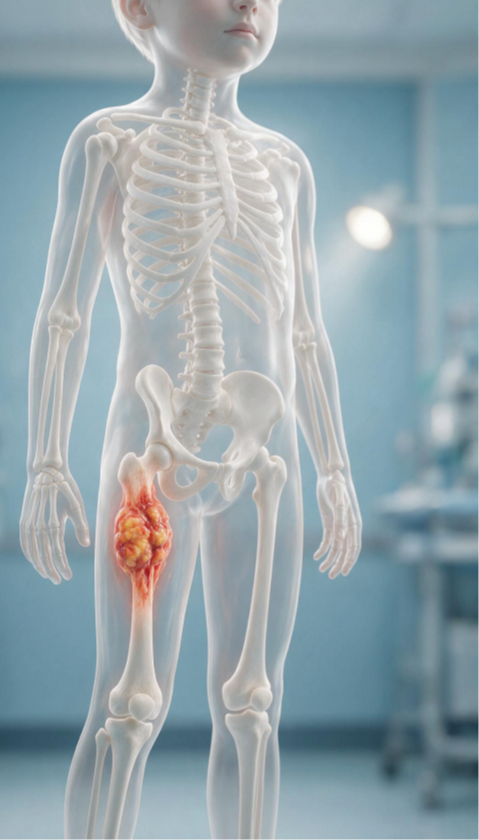
Simply put, a sarcoma is a malignant tumor that develops from the tissues that support and give shape to the body: bone, muscle, fat, cartilage, or fibrous tissue. The most common childhood bone cancer in Mexico is osteosarcoma, followed by Ewing sarcoma. There are dozens of sarcoma subtypes, but for practical purposes, the important thing to know is that they can appear anywhere in the body. They occur most frequently in the extremities (legs and arms), especially around the knees and shoulders.
How Can It Be Distinguished from Growing Pains?
Classic growing pains have a recognizable pattern: they appear in the afternoon or at night, are intermittent, usually affect both legs equally, and improve with massage or common pain relievers. With this type of pain, the child wakes up feeling well the next day, without limping or limiting activity. It is not accompanied by swelling, increased volume, or fever.
Pain associated with a sarcoma tends to follow a different pattern. These are the signs that should prompt a medical consultation:
- Persistent and progressive pain in one specific area that does not improve or even worsens over the course of several weeks.
- Night pain that wakes the patient or does not improve with common pain relievers.
- The appearance of a lump or swelling, especially if it grows over time or feels firm to the touch.
- Limping or difficulty using an arm or leg without a clear previous injury to explain it.
- A fracture caused by a minor impact or with no apparent cause (“pathological fracture”).
- Localized pain that persists for more than two or three weeks, especially if it is not related to recent physical activity.
None of these signs alone confirms a cancer diagnosis. The vast majority of lumps and pain in young people have benign causes. Even so, when these signs appear, they warrant a medical evaluation and an imaging study (X-ray) as a first step.
Why Early Diagnosis Makes a Difference
One of the greatest challenges with sarcomas is that, because they can be mistaken for sports injuries or growing pains, diagnosis is often delayed. The earlier a sarcoma is identified and treated, the greater the chances of preserving the limb through modern reconstructive surgery, and the better the overall prognosis. Late detection can limit treatment options and require more complex procedures.
A Message for Families
The goal is not to cause alarm over every episode of muscle pain during childhood or adolescence, which in the vast majority of cases is normal and temporary. The goal is to recognize the signs that fall outside that usual pattern. If your child’s pain lasts more than two or three weeks, is consistently located in the same place, wakes them at night, or is accompanied by a growing lump, do not hesitate to seek medical evaluation. A simple, timely X-ray can quickly clarify the situation, and if any suspicious finding is detected, referral to an orthopedic oncology specialist allows the appropriate evaluation and treatment to begin without delay.
Listening to our children’s bodies without fear, but with attention, is the best prevention tool we have.

DR. RAFAEL JUÁREZ TORRES
Orthopedics and Traumatology, Bone Tumor Surgery
Ixchel Medical Center, Calle Nicolas Bravo 270, Primera, 21100, Mexicali, B.C.
Phone: 686 543 1544
Instagram: dr.rafaeljuarez
Email: rafaeljuarez.tyo@gmail.com